Force and frequency
A faster mouse atrium
Both the absence of increased force and the faster beating deserve attention. Together, they put some precision into an easy description of a heart response.
Contraction force at 100 nM
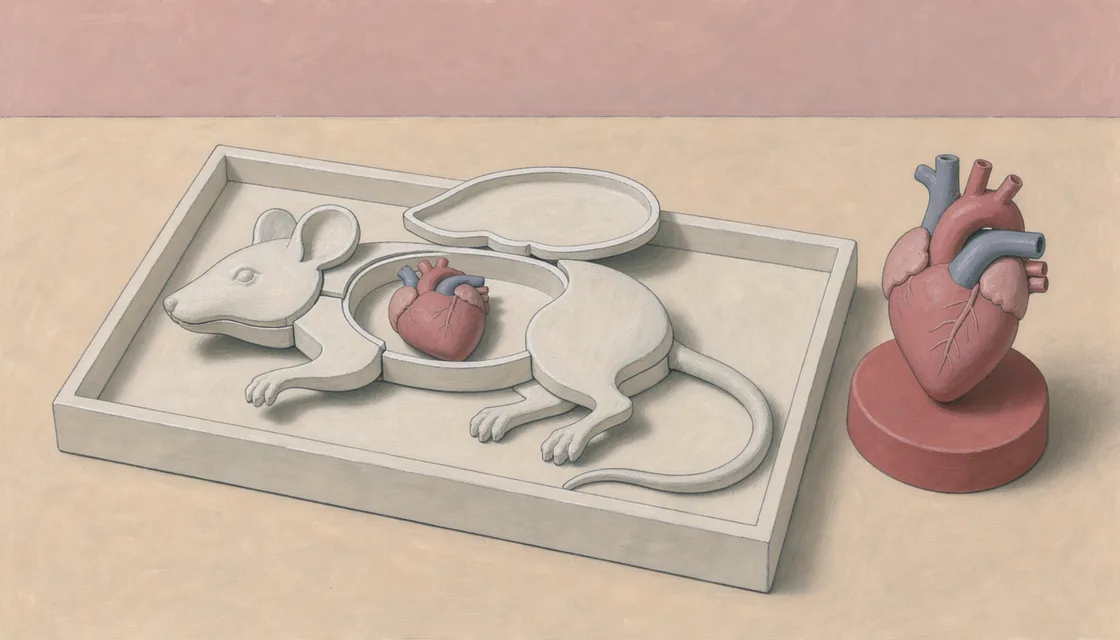
At 100 nM, retatrutide did not increase contraction force in isolated mouse atrial preparations. I might have expected this result to resemble the increased force in human atrial tissue. Instead, the comparison leaves an effect to explain.
The absence of increased force deserves a full place in the story. It stops the phrase “cardiac response” from becoming a loose container for everything the tissue might do. In the human preparation, force rose. In the mouse preparation, that particular response was absent. The difference is an experimental question before it becomes a reassuring or alarming headline.
I’d gladly trade a broad verdict for a closer comparison of the preparations and their starting conditions. A difference between species is tempting to nominate immediately, but a matched experimental comparison would make a better argument than that assumption.
Beating rate in right atrial tissue
The same paper reported a positive chronotropic effect in spontaneously beating mouse right atrial tissue: the beating rate increased. The effect was mediated through glucagon-receptor and cAMP/PKA signalling, with blockade by a glucagon-receptor antagonist and by carbachol.
“Chronotropic” concerns rate, while the human paper’s “inotropic” concerns force. The pair of terms earns its space because the mouse experiment pulled the responses apart. In these isolated mouse atrial preparations, beating rate increased without an increase in contraction force.
The clinical pulse finding now has a more specific question attached to it. The mouse work gives a mechanism to examine; the trial supplies a heart-rate observation in people. Establishing how much the isolated-tissue mechanism explains that observation would require a direct test. The clinical pulse page returns to the people.